Understanding Equipment Lifespan Expectations
Commercial HVAC equipment doesn't last forever, and knowing the expected lifespan of your system is critical to making smart financial decisions for your Phoenix business. Most commercial rooftop units (RTUs) operate effectively for 15 to 20 years with proper maintenance, while individual components like compressors, motors, and coils may need replacement sooner. On Time HVAC Phoenix serves Phoenix residents and commercial property owners by helping them understand when their equipment is approaching the end of its useful life. Air handlers typically last 15 to 25 years, condensing units 10 to 15 years, and compressors specifically 10 to 15 years depending on usage and maintenance schedules. Knowing these benchmarks helps you plan capital expenditures rather than facing unexpected emergency replacements that disrupt your operations. Premium brands like Trane, Carrier, and Daikin often deliver longer equipment life due to superior component quality and engineering, though all systems require consistent professional care to reach their maximum potential.
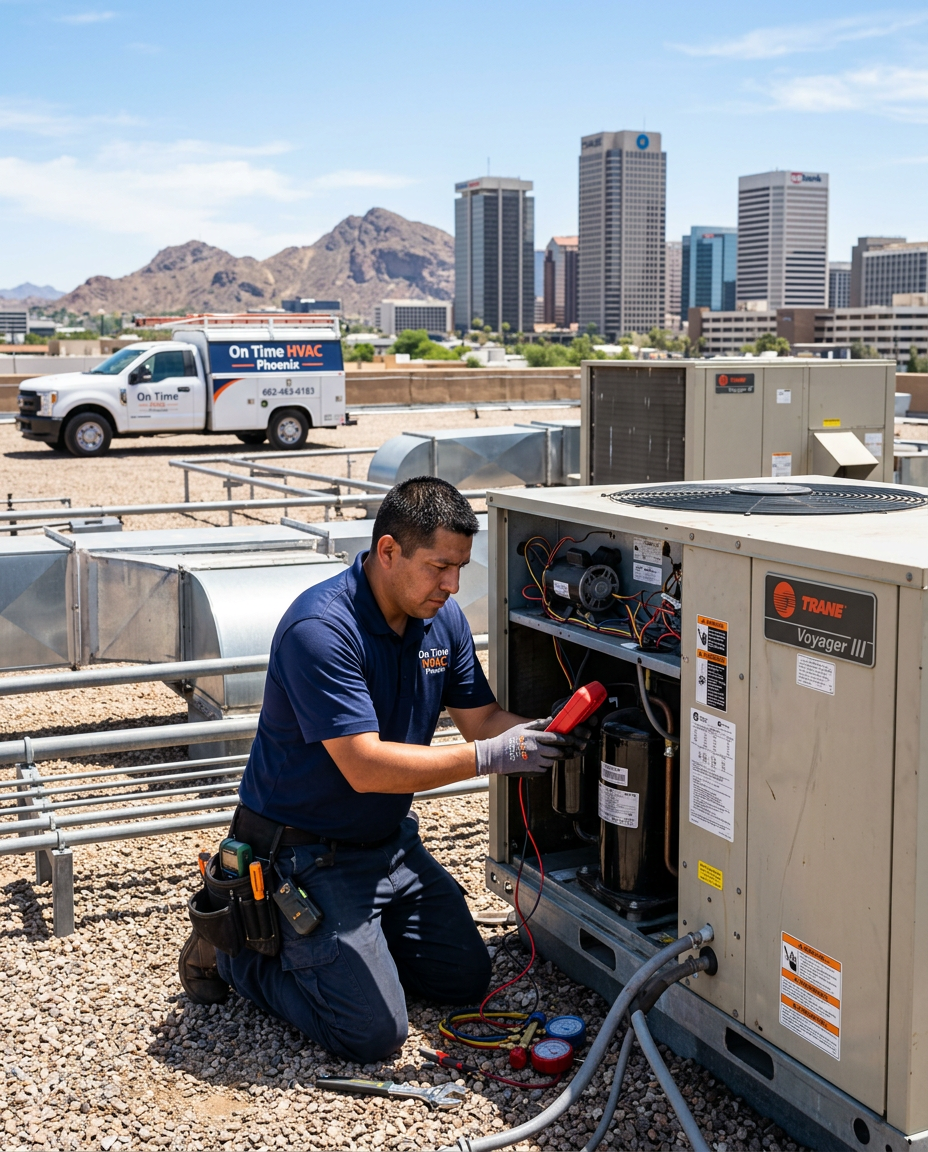 Phoenix Commercial HVAC Maintenance from On Time HVAC Phoenix at 26 E Pima St
 The 50 Percent Rule: Your Decision Framework
When your commercial HVAC system needs a significant repair, the decision to fix or replace depends largely on the 50 percent rule. This industry standard states that if the repair cost exceeds 50 percent of what a new system would cost, replacement is typically the smarter investment. For example, if a compressor replacement costs $3,000 and your system is already 12 years old with a replacement cost of $6,500, the math suggests replacement makes more sense. We provide thorough diagnostics to calculate both repair and replacement costs transparently, helping Phoenix business owners make decisions backed by honest data and backed by 5-star Google reviews from our satisfied clients. Beyond just the financial calculation, consider the efficiency gains of a new system. Modern commercial units with variable-speed compressors and inverter technology deliver 20 to 30 percent better efficiency than equipment from 2010 or earlier. This means lower monthly energy bills immediately and reduced operational strain on your facility's electrical infrastructure.
Age and Degradation: When Efficiency Plummets
As commercial HVAC equipment ages, performance degrades steadily. Systems over 12 years old typically operate at 75 to 85 percent of their original efficiency due to refrigerant leakage, compressor wear, and coil fouling from Phoenix's harsh desert dust environment. Commercial facilities throughout the downtown Phoenix area near the Children's Museum of Phoenix struggle with dust infiltration during monsoon season and heat-driven demand spikes. Refrigerant levels drop by 10 to 15 percent annually through natural leakage, forcing compressors to work harder and consume more electricity to deliver the same cooling. Arizona's extreme UV exposure and mineral-heavy hard water degrade condenser coils faster than in milder climates. If your energy bills have climbed 15 to 20 percent year-over-year while cooling output remains the same, degradation is likely the culprit. Commercial HVAC Maintenance helps prevent these efficiency losses by addressing leaks and wear before they cascade into system failure. A professional energy audit from us will reveal whether repairs can restore performance or whether replacement with a modern, high-efficiency unit makes financial sense over the system's remaining life.
Boiler System Servicing and Preventive Maintenance
While commercial HVAC systems often focus on cooling, many Phoenix properties include boiler systems for heating or hot water production. Professional boiler servicing should occur at minimum annually, ideally before the heating season begins in November. Annual servicing includes inspection of combustion efficiency, burner operation, heat exchanger condition, water pressure and temperature controls, and safety relief valve function. This preventive approach helps prevent catastrophic boiler failure during winter operation and extends equipment life significantly. We recommend that Phoenix homeowners and business owners establish service agreements guaranteeing spring and fall inspections, which aligns with Arizona's mild but unpredictable shoulder seasons. During these maintenance visits, our licensed technicians verify combustion gas analysis, descale heating surfaces to remove mineral buildup, and replace worn gaskets and seals. This preventive strategy prevents emergency repairs that can cost $2,000 to $5,000 when major components fail unexpectedly. Regular servicing also maintains manufacturer warranties and improves fuel efficiency by 5 to 10 percent.
Component Replacement vs System Replacement
Sometimes a single component failure prompts the repair-versus-replace question. Capacitors, typically lasting 5 to 10 years, cost $150 to $400 to replace and should always be repaired. Blower motors, with a 10 to 15 year lifespan, run $300 to $900 and usually warrant repair unless the system is already older than 12 years. Evaporator coils degrading over 8 to 15 years cost $600 to $2,000 to replace; repair makes sense for newer systems but less so for equipment beyond year 12. The condenser coil, critical for heat rejection in Phoenix's brutal heat, costs $400 to $1,200 to replace and lasts 10 to 15 years. When multiple components approach end-of-life simultaneously, the cumulative repair costs quickly approach replacement thresholds. On Time HVAC Phoenix helps commercial property owners catch failing components early before cascading failures occur. A wise approach is requesting a detailed component inspection report from your service provider, which outlines the condition and expected remaining life of each major part.
Phoenix's Desert Climate Impact on Equipment Life
Phoenix is located in Phoenix, AZ, and experiences extreme environmental conditions that accelerate HVAC system aging compared to mild climates. Outdoor temperatures regularly exceed 115°F from June through August, forcing compressors to work at maximum capacity for extended periods, which degrades motor windings and refrigerant oils faster. Desert dust and haboobs clog condenser coils within weeks if not cleaned regularly, reducing heat rejection efficiency and forcing components to work harder. The monsoon season from July to September brings humidity spikes and sudden flooding, potentially damaging electrical components and ductwork. Hard water with 300+ parts per million mineral content causes scaling inside pipes, coolers, and condenser tubes, restricting flow and reducing efficiency. UV radiation breaks down outdoor unit paint, insulation, and plastic components over time. We account for these harsh conditions in our maintenance protocols, recommending quarterly condenser coil cleaning instead of the standard annual cleaning recommended elsewhere. Equipment located in Phoenix's intense sun environment typically reaches end-of-life 2 to 3 years sooner than the same equipment in temperate zones, making preventive maintenance and strategic replacement planning essential.
Making the Replacement Decision: Key Factors
Beyond cost and age, several factors should guide your repair-versus-replace decision. Consider your facility's operational timeline: if you occupy the building only seasonally or plan to relocate within five years, repairing aging equipment may be more cost-effective than investing $6,000 to $12,000 in replacement. If you're a long-term owner or tenant expecting 10+ more years in the space, replacement offers better financial returns through reduced energy costs and minimal emergency service calls. Warranty status matters significantly; most commercial equipment carries 5 to 10 year manufacturer warranties on compressors and major parts, so repair costs fall within warranty coverage, making fixes attractive. Once warranty expires, component failure costs rise, favoring replacement. On Time HVAC Phoenix provides Commercial HVAC Maintenance services specifically designed to address the unique challenges facing Phoenix property owners. Our licensed technicians provide honest assessments without pressure to replace when repair remains viable. We've served the Phoenix area since 2014, building our reputation on reliability and straightforward advice that prioritizes https://marcoykno579.timeforchangecounselling.com/hvac-installation-for-multi-unit-properties-and-hoa-communities-in-maricopa-county your business goals over unnecessary equipment replacement.
Maintenance Plans That Extend Equipment Life
Phoenix homeowners frequently need Commercial HVAC Maintenance to combat our region's harsh operating conditions. The most cost-effective strategy for maximizing HVAC lifespan is investing in professional preventive maintenance agreements. Annual or semi-annual service plans cost $150 to $300 per visit but prevent 70 to 80 percent of emergency repairs through early component detection and adjustment. During maintenance visits, our technicians check superheat and subcooling measurements, static pressure in ductwork, temperature differential across the evaporator coil, electrical connection integrity, capacitor microfarad ratings, and refrigerant charge levels. These detailed diagnostics identify failing components before they fail completely, preventing compressor burnout and secondary damage. Regular coil cleaning, filter changes every 30 to 90 days, and drain line clearing prevent the buildup that reduces efficiency and strains motors. We design maintenance agreements specifically for Phoenix's desert conditions, accounting for dust accumulation, hard water mineral buildup, and extreme heat stress. Clients on our maintenance plans typically extend equipment lifespan by three to five years compared to reactive service-only customers, recovering the maintenance investment many times over in avoided replacement costs. Contact us at 602-483-6183 or visit https://ontimehvacphoenix.com/ to discuss a custom maintenance agreement for your property.
Find 602-483-6183 Commercial HVAC Maintenance services near you in Phoenix "@context": "https://schema.org", "@type": "LocalBusiness", "name": "On Time HVAC Phoenix", "telephone": "602-483-6183", "address": "@type": "PostalAddress", "streetAddress": "26 E Pima St", "addressLocality": "Phoenix", "addressRegion": "AZ", "postalCode": "85003" , "url": "https://ontimehvacphoenix.com/", "areaServed": "Phoenix", "description": "Professional Commercial HVAC Maintenance serving Phoenix in Phoenix, AZ.", "sameAs": ["https://www.facebook.com/OnTimeHVACPho/","https://www.instagram.com/ontimehvacpho/","https://www.youtube.com/@OnTimeHVACPho","https://www.linkedin.com/company/ontimehvacpho/","https://x.com/OnTimeHVACPho","https://www.tiktok.com/@ontimehvacpho","https://www.pinterest.com/OnTimeHVACPho/"], "image": "@type": "ImageObject", "url": "https://lh3.googleusercontent.com/d/11tEF0WYBKXuXq1e8AvpOQ6vyzmtxvPMT", "name": "Commercial HVAC Repair vs Replace in Phoenix: Know When to Upgrade Your Equipment Service Image", "description": "Image for: How often should a boiler system be serviced?", "encodingFormat": "image/png" , "audio": "@type": "AudioObject", "contentUrl": "https://drive.google.com/file/d/1gzVKu9K4EnrD6EHmwRI3f-MpLpaNjbOE/view", "name": "Commercial HVAC Repair vs Replace in Phoenix: Know When to Upgrade Your Equipment Expert Audio", "description": "Audio answer to: How often should a boiler system be serviced?", "encodingFormat": "audio/wav"